
Jul 2026
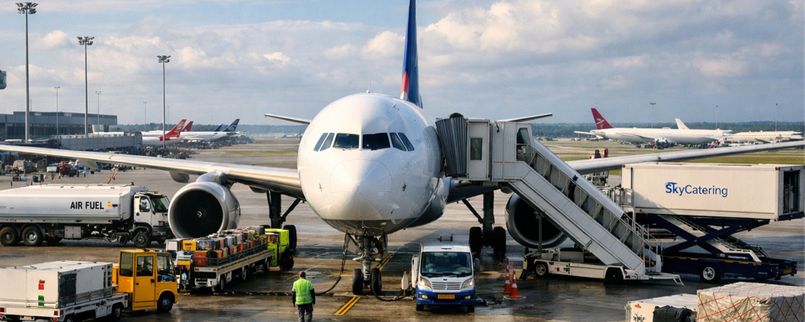
Picture the morning rush at a busy hub airport. The airline operations team is managing a late-arriving wide-body. Ground handlers are waiting on a stand that hasn't been confirmed. The terminal duty manager is watching passenger queues build at security while the flight information system still shows an on-time departure. The network operations center is calculating delay propagation for the connecting bank. The baggage team is reallocating resources based on information that is already twenty minutes stale.
Each team is doing their job. Nobody has the full picture. The delay that follows is not caused by any single failure — it is caused by the gaps between the teams. And in most airports, those gaps are structural, not accidental.
This is the reality of siloed airport operations: not dramatic breakdowns, but a continuous, quiet erosion of efficiency driven by the absence of shared context. The cost accumulates across thousands of small coordination failures every day. And as traffic volumes grow, that cost scales.
Why Silos Are an Operational Risk, Not Just an Inconvenience
Siloed operations were a manageable limitation when airports operated at lower traffic densities and disruptions were genuinely rare. Today, with global passenger volumes above 9.4 billion annually and growing toward 20 billion by 2040, the tolerance for coordination gaps has evaporated.
EUROCONTROL's research is unambiguous: disruptions rarely remain local, and recovery speed increasingly depends on coordination quality rather than individual stakeholder optimization. In a tightly coupled system — where aircraft turns depend on baggage, security throughput affects gate availability, and ground handling capacity constrains turnaround performance — a delay in one domain ripples through all others within minutes.
When stakeholders act on partial or inconsistent information, local decisions that appear rational in isolation can unintentionally amplify disruption elsewhere. A gate agent who holds a door to protect a late-arriving passenger may trigger a missed slot that cascades into a two-hour network delay. A ground handler who optimizes their team's utilization may leave a stand occupied longer than necessary, creating a knock-on constraint for arriving traffic. Without shared situational awareness, these interactions are invisible until they have already compounded.
"Recovery speed increasingly depends on coordination quality rather than individual stakeholder optimization."
The Foundation: Airport Collaborative Decision Making
Airport Collaborative Decision Making (ACDM) was developed precisely to address this problem. Its core contribution is not automation but alignment — ensuring that all stakeholders operate against the same milestones, assumptions, and time references around turnaround and departure processes.
ACDM establishes a common operational language. When the airline, ground handler, fuel supplier, and slot coordinator all see the same Target Off-Block Time and update their activities accordingly, the coordination friction that produces delays begins to reduce. EUROCONTROL's and ICAO's analysis of ACDM implementations consistently shows improvements in predictability and a reduction in unnecessary delays at the departure stage.
However, ACDM's scope is deliberately focused. It primarily addresses aircraft-centric processes: turnaround milestones, departure sequence, slot compliance. It does not, on its own, provide a system-wide operating view that connects airside performance with terminal throughput, passenger flows, security capacity, or landside access. As traffic density increases and the interdependencies between these domains intensify, this limitation becomes more visible.
What ACDM does exceptionally well is create the shared information discipline and multi-stakeholder trust that more advanced integration depends on. Airports that have successfully implemented ACDM have the data infrastructure, the governance habits, and the collaborative culture that makes the next step possible.
Extending the Logic: Total Airport Management
Total Airport Management (TAM) extends the ACDM logic beyond aircraft turnaround into a system-wide operating model. Instead of optimizing individual processes, TAM focuses on how decisions in one part of the airport affect performance elsewhere — across terminals, security, baggage, stands, and surface access.
A central element of TAM is the Airport Operations Plan (AOP): a collaboratively agreed, continuously updated rolling plan that functions as a shared reference point connecting planning, execution, and monitoring across different time horizons. The AOP is not a static document produced at the start of the day. It is a living operational picture that is updated as conditions evolve, shared across all stakeholders, and used as the basis for coordinated decision-making.
In practice, TAM shifts the airport from static planning toward continuous operational alignment. Decisions are evaluated not only on local efficiency but on their impact on overall system performance, resilience, and recovery speed. A ground handling resource allocation decision that optimizes a single airline's turn time but blocks a critical stand for arriving traffic is visible as a system-level trade-off — and can be discussed and resolved before it creates a cascade.
SESAR's airport operations management frameworks describe this shift as moving from a collection of optimized silos to a collaboratively managed system. The language is precise: the goal is not to make each part of the airport better individually, but to make the whole perform better together.
Where Plans Become Action: The AOCC
While ACDM and TAM define how information is shared and what is planned, the Airport Operations Control Center (AOCC or APOC) defines where and how decisions are orchestrated.
The AOCC is not merely a physical room or an IT system. It is a coordination model that brings stakeholders together around a shared operational picture, enabling real-time scenario evaluation, prioritization, and trade-off decisions — particularly during disruption. In the AOCC model, the authority to make cross-domain decisions is clearly defined, response protocols are rehearsed, and the information needed to act is available in a single integrated view.
EUROCONTROL's analysis of Airport Operations Centres, drawing on performance data from over 30 European airports, consistently shows that coordinated decision-making through APOC-like structures improves recovery times and predictability during irregular operations — particularly when compared to fragmented, escalation-based approaches where decisions are delayed while responsibility shifts between actors.
The effect becomes more pronounced as traffic density increases. As the buffers that once absorbed minor delays shrink, the cost of poor coordination grows disproportionately. In high-density operations, a fifteen-minute stand conflict that would have been absorbed in quieter conditions can now trigger a sixty-minute network delay. The AOCC provides the structural mechanism to prevent that amplification.
Connecting to the Network
Airports do not operate in isolation. Local decisions propagate across the wider air transport network, particularly under constrained capacity conditions. A departure delay at one hub affects arrival sequences at another. A slot restriction cascades through connecting itineraries across multiple airlines. This network sensitivity means that purely local optimization — even well-executed — can undermine system-wide performance.
The integration between the Airport Operations Plan and the Network Operations Plan (NOP), coordinated through EUROCONTROL's Network Manager, ensures that local decisions are made with awareness of network-level impacts. It also enables airports to shift from reactive compliance with network constraints toward proactive contribution to network stability — sharing updated departure estimates early enough that downstream impacts can be anticipated and mitigated.
As global traffic continues to grow at approximately 3–4% annually, even small improvements in coordination and predictability at the airport level can produce outsized benefits at network scale — while poor alignment can rapidly amplify disruption across multiple hubs.
Building the Backbone Incrementally
A critical insight from industry frameworks is that the operational backbone of a smart airport is evolutionary, not the product of a single transformation project. Airports typically progress through stages: improving information sharing and data integration, then establishing collaborative planning structures, and finally implementing centralized operational orchestration.
This sequencing matters. Attempting to deploy an AOCC without stable ACDM foundations and reliable shared data often produces a coordination theater — stakeholders gathered in a room with screens, but no common operational picture to coordinate around. Conversely, airports that build the backbone incrementally — aligning processes, roles, and decision rights alongside technology at each stage — are better positioned to scale capability and sustain performance gains over time.
The question for airport leadership is not whether to build this backbone. Growing traffic and disruption frequency will eventually make the answer unavoidable. The question is whether to build it by design — or by necessity.